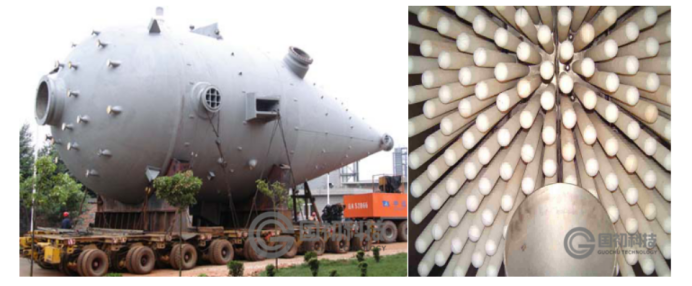
Exhaust gases emitted by various industrial furnaces and kilns in metallurgy, machinery, chemical, power and other industries are not only high in temperature but also contain large amounts of dust and hazardous gases, making them one of the major sources of environmental pollution. Under high-temperature conditions, due to significant changes in gas viscosity, a substantial decrease in humidity, and a greatly reduced tendency for fine particles to agglomerate, the separation of particulates becomes more difficult. Bag filters cannot withstand the high temperature of exhaust gases; wet dust removal makes comprehensive utilization of the thermal energy impossible; and electrostatic precipitators have issues such as high initial investment, large footprint, and insulation problems. At present, most methods for treating high-temperature industrial dust-laden exhaust gases in China involve cooling the gas with water to around 200°C, followed by dust removal using bag filters. This not only increases the investment and operating costs of cooling equipment but also results in the loss of substantial thermal energy.
High-temperature exhaust gas dust removal has the following characteristics:
(1) The dust-laden gas to be purified has a high temperature, ranging from 600 to 1400°C;
(2) The dust particles in the exhaust gas are fine, typically with a particle size of <5–10 μm, or even submicron;
(3) Purification standards are high, with outlet concentration requirements of 10–50 mg/m³, or even lower.
China currently has nearly 200,000 industrial kilns and furnaces, consuming about 200 million tons of coal (coke) annually. During production, they discharge large amounts of high-temperature dust-laden hazardous gases, seriously polluting the atmospheric environment. The characteristics of their exhaust gases are high temperature, high dust concentration, high blackness, and wide fluctuations in temperature and gas flow rate. With economic development, environmental protection requirements are becoming increasingly stringent. Therefore, new high-temperature industrial exhaust gas dust removal technologies are an important topic that urgently needs to be developed.
Since the 1970s, developed countries have continuously researched ceramic membrane filters of various materials and structures for high-temperature filtration and dust removal, achieving good results. The main physical performance indicators of ceramic membranes are porosity, permeability, and bending strength. Studies have shown that compared to other types of dust collectors, ceramic membrane filters have high dust removal efficiency, reaching over 99.99%, and can remove dust particles larger than 5 μm. They have a simple structure and, most importantly, are resistant to high temperatures, operating at temperatures above 800°C, and exhibit good corrosion resistance under high-temperature oxidative or reducing environments. Therefore, ceramic filter dust collectors play an important role in high-temperature dust removal.
Based on the filtration performance of ceramic membranes, various types of filtration devices can be developed. The main applications are summarized as follows:
(1) Ceramic filter dust removal devices in coal-fired power plants. This is considered one of the most reliable dust removal technologies. Due to increasing environmental awareness, electrostatic precipitators currently used in coal-fired power plants are likely to struggle to meet future environmental legislation requirements.
(2) Ceramic membrane filter dust collection devices in the metallurgical industry. In non�ferrous metal smelting, rotary drying kilns are widely used for drying concentrates and leaching residues. These kilns generate large amounts of flue dust containing fine metal particles, causing environmental pollution. Because the temperature of the drying kiln flue gas is very close to its dew point (45–65°C) and the gas is hygroscopic, condensation easily occurs, making dust collection difficult. Ceramic membrane filters for high�temperature dust collection can effectively solve this problem.
(3) The new clean coal combustion process – Integrated Gasification Combined Cycle (IGCC) – is a new high�efficiency power generation technology that countries around the world are investing in and developing, and is expected to be commercialized in the 21st century. Using ceramic membrane filters to remove dust from high-temperature gas after the coal gasification reactor and desulfurization unit is the best technical route.
(4) Industrial gas purification, especially high�temperature flue gas and chemical industry gases, including the removal and purification of solid particles from raw gas in industrial processes and the removal of solid particles from tail gases, directly affects the service life and operational safety of downstream equipment. Moreover, the airborne dust (particles smaller than 10 μm) in these industrial flue gases poses a risk to human health. Ordinary dust collectors are difficult to meet these treatment requirements, but inorganic ceramic membrane filters excel in such applications.
(5) Recovery of valuable powders, especially high�value-added dust. Examples include recovering catalyst from fluidized bed equipment in petrochemical plants, collecting powder during pneumatic conveying and spray drying processes, and recovering powder in nanomaterial production and other ultrafine powder manufacturing processes.
(6) With increasingly stringent environmental protection requirements and to protect human health, processes such as waste incineration, particularly the incineration and volume reduction of hazardous waste (including radioactive and infectious waste), for example medical and other waste incineration related to SARS, require effective methods to prevent hazardous dust from polluting the atmosphere. Using high�efficiency ceramic membrane filters is a practical and feasible approach.
Application Fields:
High-temperature dust purification and material recovery in the silicone and polysilicon industries
High-temperature, high-pressure gas purification and catalyst recovery in the petroleum and chemical industries
High-temperature dust purification, process gas and valuable material recovery in the chemical industry
High-temperature flue gas purification in metallurgy and smelting, especially recovery of high-value dust (e.g., platinum, rhodium, nickel, tin, lead, copper, titanium, aluminum, etc.)
High-temperature, high-pressure coal synthesis gas filtration and coal retort synthesis gas purification in coal chemical industry
High-temperature gas purification in calcium carbide, ferroalloy processing and other fields
High-temperature synthesis gas purification in biomass gasification and oil shale gasification
Dust removal from high-temperature gas in Integrated Gasification Combined Cycle (IGCC)
Main Advantages:
High temperature resistance: Capable of continuous and stable filtration at temperatures up to 550°C
Corrosion resistance: Resistant to H₂S, SO₂, Cl₂, HF, etc.
High filtration precision: Emission concentration ≤2 mg/m³, dust particle interception size ≥0.1 μm
High gas permeation flux: With dust interception size ≥0.1 μm, ceramic membrane permeation flux ≥120 m³/(m²·kPa·h)
Good thermal shock resistance
Waste heat can be recovered and utilized, conserving resources
Good regeneration performance and long service life