
Food and Beverage


Tea is a resource of significant advantage in China, and the rise of the tea beverage industry has accelerated the industrialization of deep tea processing. Currently, turbidity remains one of the major technical challenges in tea beverage production. The primary cause of turbidity is often attributed to complex coagulation and flocculation among tea polyphenols, caffeine, soluble proteins, pectin, and other substances present in tea infusions. Traditional separation and extraction methods—such as mechanical filtration, high-speed centrifugation, and chemical treatments—often yield poor clarification results and produce lower-quality products. Integrated membrane separation technology, based on inorganic ceramic membrane separation, offers a solution to these problems: large-molecule components like proteins and pectin are effectively removed by ceramic ultrafiltration membranes, while valuable active ingredients—including tea polyphenols, caffeine, amino acids, and catechins—are maximally preserved, ensuring both the flavor and stability of the tea beverage. Furthermore, after clarification, the resulting tea juice is concentrated using reverse-osmosis membranes, replacing the conventional evaporation-based concentration process.
Process characteristics
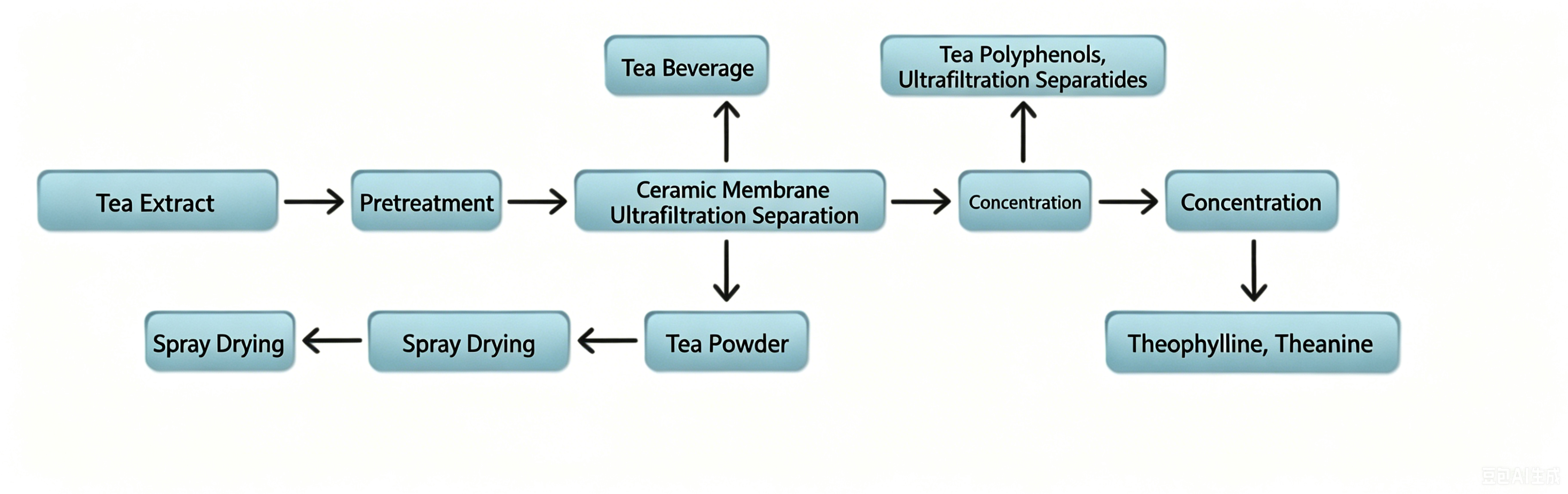
The loss of effective ingredients such as tea polyphenols, caffeine, and amino acids is minimal, thereby enhancing product purity.
No chemicals need to be added, and it is pollution-free with no residue—making it a green and environmentally friendly technology.
Compared to organic ultrafiltration membranes, ceramic ultrafiltration membranes can be cleaned using strong acidic and alkaline oxidizing agents with a pH range of 0 to 14, allowing for thorough cleaning and regeneration, and thus boasting a long service life.
The filtration process uses only pressure as the driving force for membrane separation, and the separation device is simple, easy to operate, and its process parameters are easy to control. Process simplification, shorter workflows, and a significantly reduced production cycle.
Ceramic membranes exhibit high resistance to fouling, require minimal pre-treatment of tea extracts, and can maintain high flux filtration for extended periods.
Ceramic membrane elements are high-temperature resistant and can be sterilized using steam and oxidizing agents. The content of impurity proteins, tannins, and pectin in the filtrate is significantly reduced, thereby minimizing membrane fouling during subsequent reverse osmosis membrane concentration, increasing flux, and extending both cleaning cycles and service life.
The membrane pore size is asymmetrically distributed and can be backflushed online. The accompanying reverse-osmosis concentration process is carried out at room temperature without phase change, thereby avoiding the drawbacks of conventional evaporation-concentration processes, such as high energy consumption, significant loss of aroma, high product viscosity, and tendency to re-mixing.
