The pharmaceutical industry needs to keep the CO2 level in process water extremely low to control the water’s conductivity and pH. Membrane contactors (degassing membranes) can effectively reduce CO2 levels, thereby maximizing the efficiency of deionization processes. This product can also remove dissolved O2, reducing the risk of oxidation and degradation in the final product—without the need for chemical agents—and simultaneously saving space, time, and costs associated with producing purified water. The Necessity of Deoxygenation in Pharmaceutical Water.
In the pharmaceutical manufacturing process, dissolved oxygen in water can lead to the following problems:
Drug oxidation and degradation: Oxygen molecules react with active pharmaceutical ingredients (APIs), affecting the stability and efficacy of the drug.
Microbial growth: Aerobic bacteria multiply rapidly in oxygen-rich environments, threatening sterile production conditions.
Equipment corrosion: Oxygen corrosion in pipeline systems leads to the dissolution of metal ions, contaminating the water quality.
The Chinese Pharmacopoeia explicitly stipulates that the dissolved oxygen content in water for injection must be ≤ 0.1 mg/L. Traditional methods such as vacuum degassing towers and the addition of sulfites suffer from high energy consumption and pose risks of residual chemical agents, making it urgently necessary to develop more efficient and environmentally friendly solutions.
Guochu Technology’s membrane contactor offers a reliable online solution that is more cost-effective for removing dissolved gases. Feedwater enters the membrane contactor from the outside (shell side) of the microporous hollow fibers. Since the hollow fibers are hydrophobic membranes, water cannot pass through the tiny pores in the membrane walls. However, dissolved gases can permeate these pores and enter the inside (tube side) of the hollow fibers, where they are then discharged through the tube-side ports.
A vacuum is applied to the shell side of the hollow fiber, reducing the gas pressure in contact with the water and thereby creating a driving force to remove dissolved gases from the water (see Figure 1).
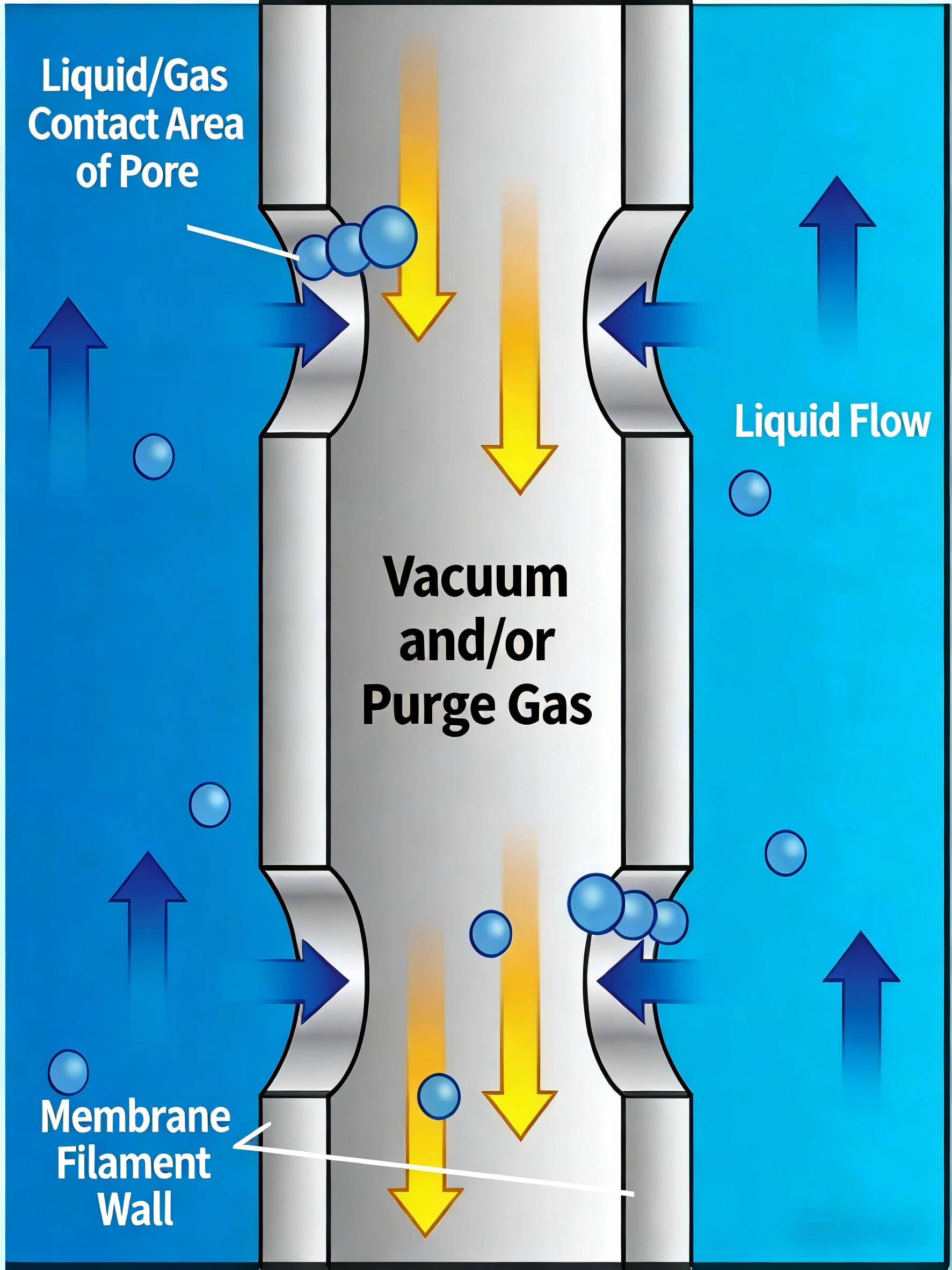
Membrane Contactor Technology Principle
The membrane contactor utilizes microporous hydrophobic membrane materials (such as PP and PTFE) to create a gas-liquid separation interface, achieving efficient oxygen removal through the following mechanism:
Driven by Henry’s Law: A low-pressure environment (typically ≤50 mbar) is established within the membrane module, reducing the oxygen partial pressure and promoting the diffusion of dissolved oxygen from the liquid phase into the gas phase.
Membrane pore selective permeability: The membrane contactor allows gas molecules to pass through while blocking liquid permeation, enabling efficient gas-liquid separation.
Counter-current design: The carrier gas (such as nitrogen) comes into contact with the water flow in a counter-current manner, enhancing oxygen mass transfer efficiency.
Process Advantage Comparison
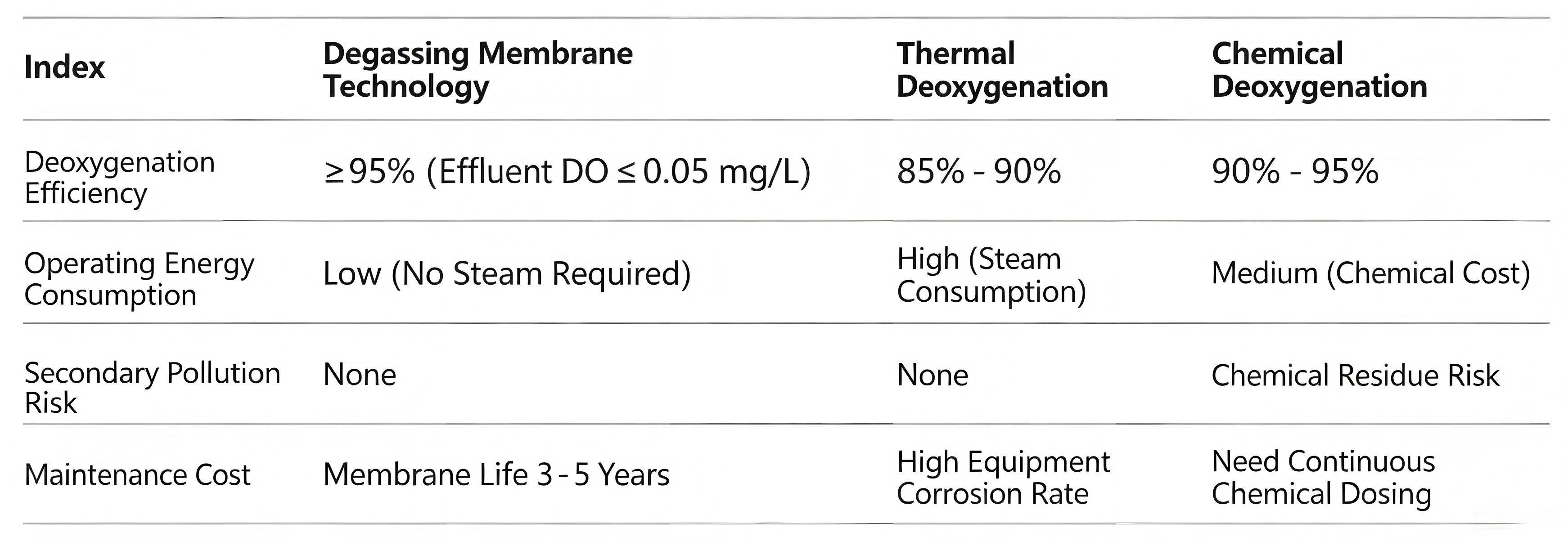
Features and Advantages
Compact equipment, saving space: The membrane contactor features a compact structure and occupies a small footprint, making it ideal for both new projects and retrofitting existing equipment, and facilitating easy installation and maintenance.
Low energy consumption, energy-saving and environmentally friendly: Compared to conventional technologies, membrane contactors have lower energy consumption and operating costs, meeting the requirements of green production.
Easy operation and high degree of automation: The membrane contactor is easy to operate, highly automated, features rapid startup, and has low maintenance costs.
Reducing secondary contamination: The gas side does not come into direct contact with pure water, thereby avoiding the risk of secondary contamination.
Flexibility and scalability: The modular design supports flexible expansion, allowing the equipment scale to be adjusted according to needs.
Long service life: The degassing membrane boasts stable performance and a long service life, reducing equipment failures and downtime, and lowering maintenance costs.
Thanks to their high efficiency, safety, and energy-saving features, membrane contactors from Guochu Technology are gradually becoming the mainstream choice for oxygen removal in pharmaceutical water treatment processes. With advancements in membrane material science and automated control technologies, this technology will further enhance its value in ensuring drug quality, reducing production costs, and promoting green pharmaceutical manufacturing.